
Published 26/06/2026
Monster Hunter G

Monster Hunter is a strange series, age-wise. Maybe it’s because the series only really popped off in the public consciousness with the release of Monster Hunter World, but it certainly doesn’t feel like a series that has existed for more than twenty years now. Whilst the core concept of the series has never really wavered - killing and capturing monsters of increasing size and ferocity - the systems around that concept have ballooned, warped, expanded and twisted in the two decades since. So going into this game, I knew it’d be a far cry from the games I’ve now spent hundreds of hours in. And yes, there are elements of Monster Hunter G, the earliest Monster Hunter title I’ve tried out, that have aged poorly, but playing it, I can see how this series got its legs. Because even if Monster Hunter G is not always fun, it’s always interesting seeing where the series began, how simplistic (comparatively) it was
Monster Hunter G is the Japanese-only PS2 standalone expansion for the original Monster Hunter, providing new monsters and quests to the base experience. Unreleased in the west, I’ve only recently been able to give it a shot with the advent of the Old-School patchers that’ve been working on getting these old games - both their offline and online components - working for the general public. I could’ve played Monster Hunter’s original 2004 release, since that actually got localised, but I wanted to engage with the online a little bit, even if this review is mostly centered around the singleplayer. So it’s sort of a dual review of Monster Hunter and Monster Hunter G at the same time.
Despite any preconceptions I held that Monster Hunter’s original generation was a barely functioning, jank-filled mess, I was quick to understand that this is still just Monster Hunter, and inherently feels just like the Monster Hunter of pre-World days. The format is exactly the same as today, just with every bell and whistle stripped away (or yet to be forged, to be more accurate). Head out on quests, hunt gigantic monsters that’ll take anything from ten to fifty minutes to kill, carve materials from them, then use all that to earn cash, craft weapons and armour, all in the service of fighting bigger and more dangerous monsters to rinse and repeat that pattern until you’re satisfied. The difference here is that the scale is so much smaller, but at the same time, each milestone you reach feels that much bigger. Each new weapon or armour piece can feel like the straw you can use to break the monster’s back, the very last tool in your bag, the thing that holds back the darkness. More than anything that came after, Monster Hunter G is exactly what it says on the tin.

Birth of the Beasts
Playing the original ‘generation’ of Monster Hunter titles has been a daunting task, largely due to the almost mythically infamous status its outdated designs have attained in the fandom. And they’re right - though I think more than a bit of hyperbole came into play. The biggest thing you’ll notice upon setting out on your first hunt is the fact that you largely don’t attack using any of the face buttons like more modern titles - all moves are tied to flipping the right analog stick in a certain direction, chaining them together to do little combos and the like. It’s… odd, to say the least, but once I got a handle on them, learning that the face buttons are *just* for menus and the D-Pad controls the camera, it really wasn’t that bad, if a little finicky.
In later games, each weapon in Monster Hunter’s armoury felt so fully formed it felt like they were always there, but that certainly isn’t true - Monster Hunter G only features five different weapon types: Hammer, Dual Blades, Sword (and Shield), Lance, and Great Sword. And sure, it’s an early game, but each one’s moveset feels so incredibly limited that it really feels like you’ve only got one or two avenues of attack. I said that the unorthodox control scheme wasn’t *that* bad, and I think a big reason is there just isn’t that many moves you actually perform, so there’s just a whole less room to mess up inputs. No matter which direction you slap the analog stick, the Hammer will do the exact same thing, and even the Sword & Shield’s variety of moves don’t matter much here. Weapons are honestly pretty unexciting, but they’re serviceable enough to get the job done, and kind of fit the tone of the game overall via that.
In regards to fighting the actual monsters, it’s fascinating seeing the exact same behaviours monsters displayed in later games perfectly preserved in their original forms. But from the jump, I found this to be a much harder difficulty curve than in later games. That isn’t to say I was getting my ass handed to me by Velocidromes and Yian Kut-Ku’s… but to say I was breezing through the early game would be a lie. A combination of the unorthodox controls, awkward cameras, more aggressive monsters and weaker skillset, Monster Hunter will not hold your hand from the jump. I just wish there were more of them; few of Monster Hunter’s most iconic monsters debuted in this initial generation of games - you’ve got Rathalos, Diablos, and I guess Yian Kut-Ku… but beyond that? None of the other monsters I battled in my time with Monster Hunter G felt like iconic, exciting encounters the level of later game’s Nargacuga, Lagiacrus or Gore Magala - and considering, just from age, that these are the ‘worst’ versions of many monsters… Well, it’s not the best roster in the world.

Over the years, the lower tiers of monsters - the Yian Kut-Ku, the ‘Dromes, hell, even Rathalos himself, have all become little more than roadblocks on the road to the real hunts… but Monster Hunter G teaches you quickly to fear even the most simple fight. It was probably a combination of getting used to the unusual control scheme and the general weightier feel of combat, but enemies felt stronger from the jump, harder to hit, and a lot more brutal when they hit *you*.
My weapons felt weaker, constantly bouncing off hardened shells and requiring constant upkeep. And, perhaps most brutally, the surrounding wildlife - the raptor like Velociprey, the Bullfangos, and a myriad of Felynes all honed in me as I tried to stay alive against my hunting targets. Monster Hunter will always be a game about thriving in a hostile environment, but the hunting environments you encounter in Monster Hunter G aren’t just hostile - they’re downright malicious. More so than ever, I felt like the underdog in every encounter, barely holding my own, and it’s an electrifying feeling that sometimes the game can’t quite keep up with. Monster Hunter feels the best when you’re either outright dominating a monster you’ve mastered the hunt of, or when you’re barely staying on the edge of survival. And whilst you very much can reach domination in this game, the latter experience feels tough to skirt because the game occasionally veers into the territory of annoying rather than exciting.
Not once did I ever feel the game held my hand during these battles - in fact, more often, it felt like it actively despised me; and not in the ‘friction breeds excitement’ kind of way. Monsters rarely stay in one place, constantly flying and burrowing to the different areas that make up any one hunting map. But they’ll frequently do after spending less than a minute in any spot, or worse - just flat out leave the moment *you* enter the map. To make matters worse, a lot of the flying monsters, especially the Rathalos and Rathian, will actively spend a minute or more flying around in the sky, totally out of range and not at all worried about you, before *then* heading off to a different area. Look, I get it. The game wants to convey you’re just a piddly little sprout of a hunter, barely a speck of dust to these majestic wyverns… but too often, this aloof behaviour in the game’s more epic fights sucked the wind out of my sails.
But the biggest thing I noticed was a lot less polish in the realm of hitboxes. Now, whilst there are a few infamous examples in more modern titles - hey there, Plesioth’s hipcheck - Monster Hunter is well known for having pretty precise hitboxes on enemy attacks, making you generally feel that if you didn’t physically get touched by an attack, you’ll avoid it. Not true here. The amount of times a monster’s tail would soar over my head - sometimes with as much as A HEAD of clearance) and I’d be sent spinning to the ground. Grazed by a passing wing? Ooh, that’s going to hurt. It’s not awful by any metric, but you’ll be having more than a handful of frustrating moments where you 100% want to call BS on a janky hitbox.

Against The Wilds
But the thing that got me past the archaic controls and janky foibles is that this truly feels like the ultimate delivery of Monster Hunter’s mission statement. The premise of you, a lone hunter, utilizing everything and everything they can get their hands on to take down some of the most monstrous creatures imaginable. Every successive game has lessened the grind for weapons, armour, items and consumables, but there is nothing to abate that journey here. I had to grind out everything; spending quest after quest stocking up on herbs and mushrooms for potions, webs for traps, materials to create bombs and ore for weapon upgrades. After a couple of hours, every initial fight with a new monster was a twenty-to-half an hour bout that pushed me to my limit, utilizing everything I grinded out for the smallest possible advantage. Potions feel precious - Mega Potions feel like a gift from the heavens. And sometimes, even all that preparation wasn’t enough, and I have to go back to the grind, building out new weapons, new armour sets, basic new strategies to stand a chance against the endless monsters. More than ever, playing Monster Hunter felt rewarding, even from its least threatening foes.
In line with the more simplified weapon designs, there’s a whole lot less weapon trees to build along, which leads to a heavier grind for specific materials to keep you on the treadmill. I hope you don’t mind running the same quests over and over again, trying to get that one specific drop from that thrice-damned Yian-Kut Ku. Hell, that’s preferable to the hell of trying to farm out a number of bugs or ore for your upgrades; there’s no quests or options to just freely explore zones, so you’ll have to run basic quests again and again just to be able to access these resource nodes which is pretty damn annoying at the best of times. It wouldn’t be until Monster Hunter Freedom unite that I felt they better balanced the grind for materials between actual monster hunting and the mining/fishing/bug catching gauntlet, but it was early days - I can’t be too annoyed, and it can be pretty relaxing to just run some hunts whilst watching something on the side.
The biggest surprise was, for the first time ever, I found money to be the thing that limited my growth the most. Quests pay out diddly squat, and comparatively, gear felt prohibitively expensive. So how else are you going to afford your gear? Well, unlike later games where you’ll be letting tens, if not hundreds, of monster parts fill up your limited storage space, they’re much better off being sold off at market. Don’t be afraid - it’s the best usage of them, and unless you’ve managed to get yourself onto the unofficial online services (utilizing perfectly legal methods, of course), it’s really going to be the only way you’ll afford that shiny new sword or armour set you desperately need to stop Rathalos from cooking you alive. I sure did. But seriously, I really like how tight money is in the early days; it’s in line with the story’s profession of you starting as ‘just another Hunter’, so of course you can barely afford the essentials!

It’s A Simple Life
And on that note - progression in the game is stringent and straightforward; there’s no real story, outside of the occasional murmuring or mutterings from villagers about a potential monster looming over all, but you’re not a hero of ages or anything; you’re a hunter, and your job? Hunting monsters! All you need to worry about is heading over the Village Chief and clearing through the list of quests he has on offer. Go hunt Rathalos. Go gather some mushrooms. Capture this. Kill three of that. It’s ridiculously basic, but it’s perhaps as immersive as Monster Hunter can get. You feel like a Hunter - not a slayer of demigods. It almost makes it feel like a nine to five job in the village, rather than the world-trotting lifestyle that’s present in later games.
There’s no other larger framework or justification for what you’re doing - you’re just doing your job, and I *love* the simplicity. As much as I adore the later games, there’s always some Elder Dragon threatening the very world’s ecosystem to contend with, some unknowable force that takes everything and everyone to bring it down. When the game’s final story encounter is damn Monoblos of all things… It's almost a metaphor for how small Monster Hunter was from the beginning, and how goddamn big it got where it’s now. Of course, there’s a plethora of tougher beasts to handle after the credits roll - and if you manage to get online - but just from the game’s general ‘story’... I love how low stakes the adventure is.
A slightly annoying element is that the Chief just gives you a randomized selection of five quests from each tier; thankfully, there aren’t *that* many quests in each tier, but if you’re trying to target a specific quest or monster, especially in the 4 or 5* tier, it can require just whaling on some of the weakest monsters in the game to make it appear. And that can take like… less than a minute, so it’s not *really* an issue.
The Ravages of Time

But for every element of this game that fascinates me, there’s always an element that pulls me away. The biggest issue, at least when I was fighting the titular Monsters, was actually keeping track of what the hell was going on. The camera in this game is *rough*, to say the least. Since, of course, you’re dishing out your moves using the right analog stick, you’re essentially locked to using the D-Pad to control the camera, or slamming the L button to recenter the camera behind you. It just feels awkward on your hands - trying to move, fight, and maneuver the camera just doesn’t work unless you’ve somehow developed a third arm. It’s usable, but there’s a reason Monster Hunter took off a lot better on a home console. Using the camera alone isn’t great, but the camera’s ‘placement’, for lack of a better word, makes things even harder to contend with.
The first few maps in the game have a lot of foliage, making them lovely to look at, sure, but it was *constantly* coating the screen, consistently veiling everything in vegetation that I really need to see behind. There were at least half a dozen deaths that I can think of alone that were just because genuinely the entire screen was obscured *and* was rammed up against the wall, making the entire screen a mess of my hunter’s back shoved up in the screen, with weeds and trees filling in the rest.

But honestly, beyond the control and camera issues, the biggest issue with Monster Hunter G is its amount of variability. Being the expansion to the first generation of Monster Hunter, the depth of its monster roster - an element as important to the series as a roster of Pokemon is to any given game of that series - is fairly lacking. The original title featured sixteen monsters, with several, such as the Dromes feeling like reskins of one another. Monster Hunter G does little to remedy this; whilst it adds thirteen additional monsters, they are all subspecies - themed alternative versions - of previously added monsters, with only a handful of those feeling like distinctively different encounters.
To make matters worse, a decent chunk of *those* aren’t even available on the offline version of Monster Hunter G, and whilst it is possible to connect to the online servers through some tricks, reaching those new subspecies online is a grind all of its own. I suppose a smaller roster leads to more focussed grinds, but fighting the same Yian Kut-Ku or Rathalos again and again, just with another coat of paint isn’t the most interesting set of engagements in the world.
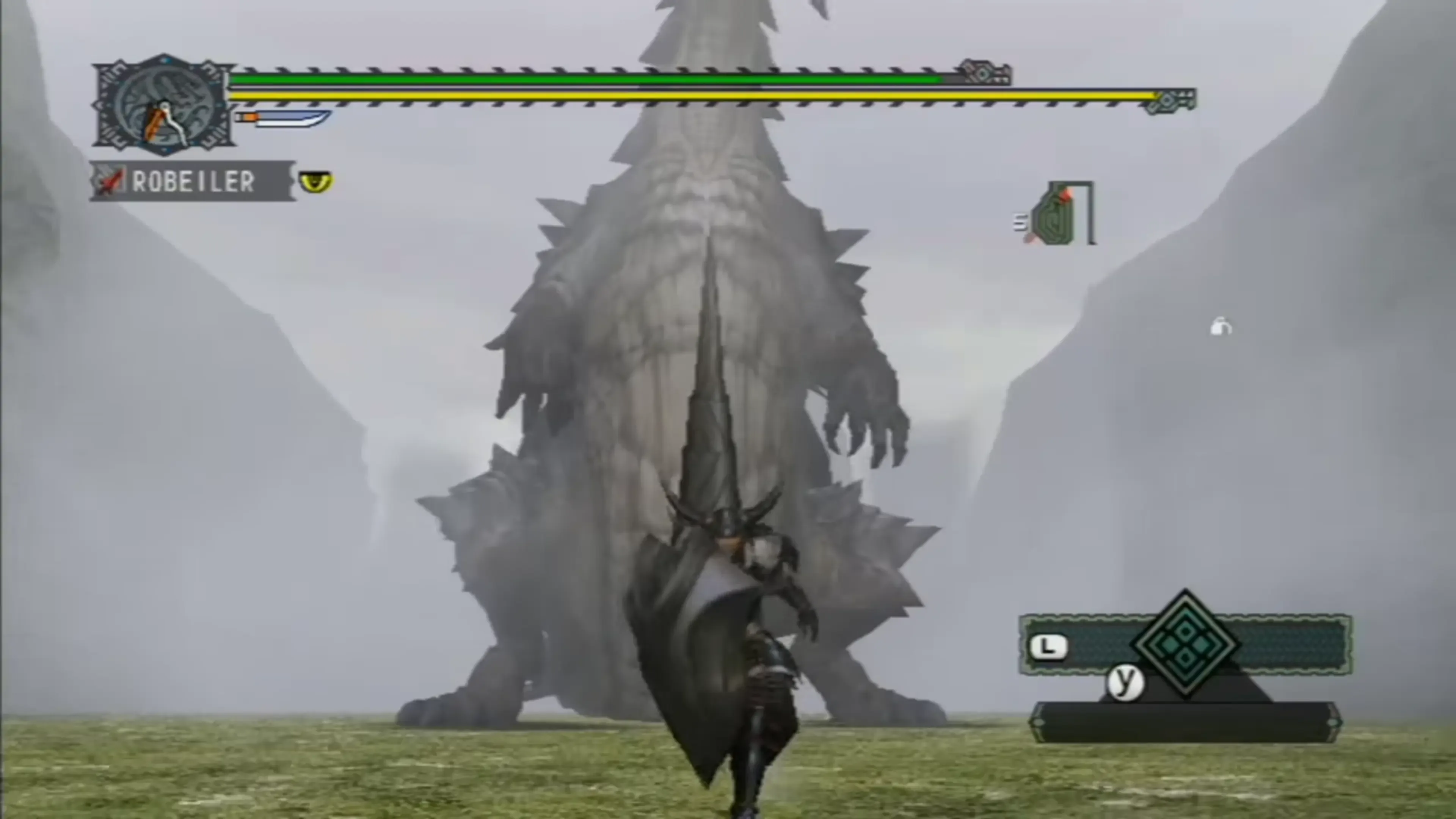
Finally, on a visual level, the game looks… fine, I suppose. With the caveat that the game was always a mid-era PS2 game, it’s aged serviceably, though mostly in the monster fidelity. All the beasts look incredible for the time, already feeling fully-realised from the jump. It’s just the zones you’ll be wandering aren’t nearly as interesting - and as I already explained, in the case of the Forest and Jungle zones, full of WAY too much vegetation to get in your way. But even in the zones where that isn’t the case… I dunno, the desert is just endless dunes and rocky hollows, and the Volcano *and* Swamp are just endless grey vistas. It’s serviceable, but very, very unexciting to be in. Thankfully, you’ll be spending more time trying not to die, so you won’t have time to worry about the monochrome swamp!
Monster Hunter G feels like a time capsule of a time when Monster Hunter was still finding it’s feet. And it certainly stumbled on its first few endeavours; whilst the analog stick attacks aren’t as atrocious as I feared, the camera is wack at worst and utterly abhorrent otherwise. The roster is rough in its depth, and the lack of variety in weapon and moveset makes it hard to recommend over later, more well-polished titles. But there is something fascinating about playing this game; its simplicity is to its benefit, the grind (usually) satisfying to overcome. I think, realistically, Monster Hunter G is best treated as a history lesson, to see where it came from, but if you can really dig into its systems, I think it’s something really special, and a testament to how Monster Hunter became the juggernaut it is today.