
Published 23/08/2025
Daikatana (GBC)
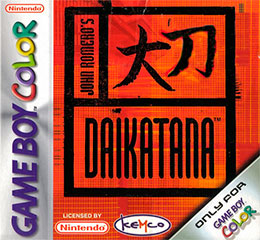
I think amongst the big, disastrous video games of infamy, Daikatana is somewhat forgotten these days. Coming out in 2000, it seems lost amongst the far more famous console flops of the era, like Superman 64 or Bubsy 3D, games that people still talk about as these all-time garbage titles. But to those aware of just how revolutionary games like Doom or Quake were, the fact that Daikatana is such radioactive garbage is insane. Pretty much every element was criticized, and led to John Romero, one half of the brains behind Doom, the game that changed PC gaming forever, being mocked for the game’s tagline which is perhaps more infamous than the game itself: John Romero is going to make you his bitch.
But this is not a review of John Romero’s PC disaster, Daikatana; no, this is a review of John Romero’s Daikatana, released for the Game Boy Color by Japanese developer Will. Perhaps one of the most fascinating port slash demakes I’ve ever really stumbled across, since voicing the very concept feels totally insane - what if instead of being a boomer shooter by one of the creators of Doom, it was a top-down, action-adventure with more in common with Link’s Awakening then Quake? The very fact it exists - the very fact that the game was *pitched in the first place* - is so fascinating to me it basically forced me to play it there and then.
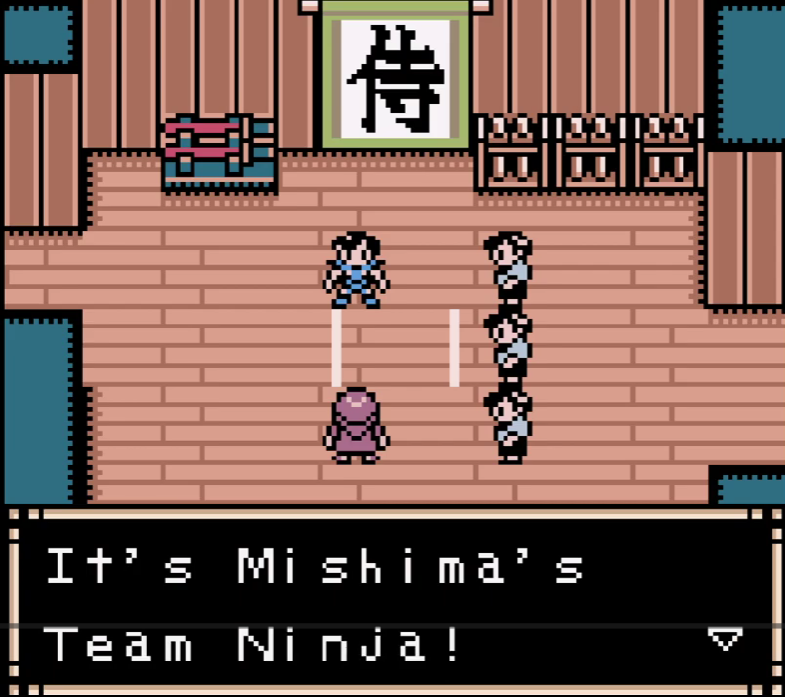
But no, it did not make me John Romero’s bitch.
Sadly, despite being an apparently much more complete, functional, and overall entertaining game than its PC predecessor, John Romero’s Daikatana for the Game Boy Color did not make me his bitch. It is a game that, by today's standards, stands on its own, and is worth engaging with simply by the virtue of its existence; the kind of game that rarely makes any major stumbles, but equally rarely ever sticks a toe beyond the line of mediocrity. But I didn’t hate my time with it - it’s a unique experience that I’m truly sad we don’t get these days, and the fact it’s just *so* unlike the pile of shite that PC Daikatana consists of is incredible.
Obviously, directly porting Daikatana to the GBC is an impossibility, but even creating a facsimile of the infamous FPS would be nigh-on impossible. The only games on these handhelds, for the most part, that actually worked in this perspective were first-person dungeon crawlers like Mysterium or Sword of Hope, nothing remotely as ‘fast’ and ‘dynamic’ as Daikatana (or at least how it was supposed to be). As opposed to the FPS infamously released on the PC and Nintendo 64, the Game Boy Color edition of Daikatana is an almost totally different experience in all but its narrative structure. Gone is the first-person gunplay, Daikatana for the GBC is a top-down action-adventure most easily compared to the Zelda titles on the handheld, largely Link’s Awakening. It’s a bold, decisive choice rather than trying to ape what they simply couldn’t, but none of the game’s shortcomings come from this decision.
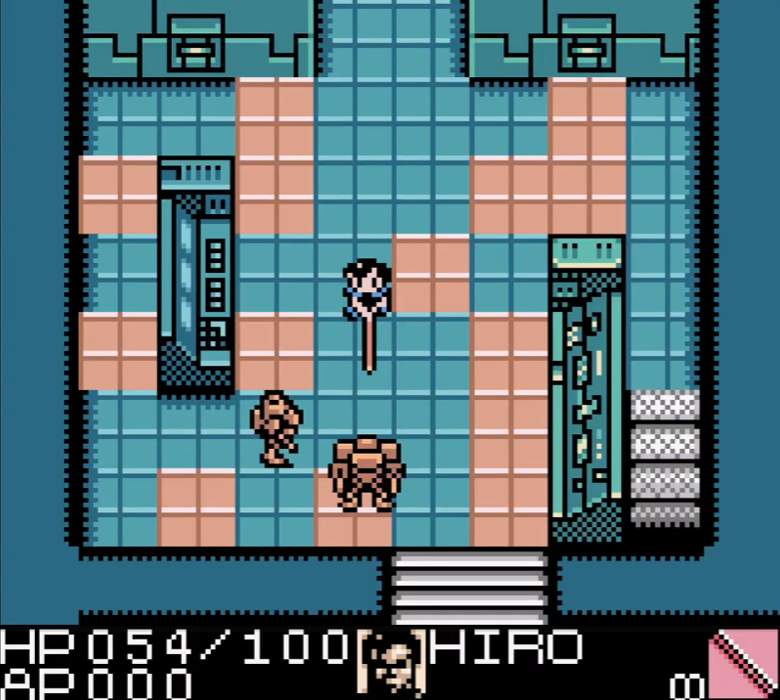
Daikatana’s plot, characters and setting are the only things that survived the transition to the 2D world; taking place in the far, apocalyptic future, warrior Hiro Miyomoto scrapes out a living as the master of a dojo, before being informed about the history of his family, and how the Daikatana was seized by a warlord named Kage Mishima to alter time and enslave the world. Hiro, soon joined by Mikiko, whose fate is also entangled with that of the Daikatana, along with Superfly Johnson, a soldier (and the best character in the game) who feels ripped from a futuristic sci-fi flick, embark on a journey that sends them through time and space itself to reacquire the Daikatana and bring an end to the dark future they live in.
Daikatana’s plot is inoffensive and transient, really just being a vehicle to move you from place to place, but it’s still delivered rather awkwardly, with a ton of grammar mistakes and an odd translation that makes it pretty hard to follow the intricacies of what’s going on or who is responsible for who. It all culminates in an ending that’s kind of a head scratcher largely because of the botched translation and left me just confused then anything else. Overall, it’s just an odd decision to even have so much storytelling on the Game Boy Color, a handheld infamous for being able to showcase little text due to screen real estate and sheer limits on cart size, but I suppose it’s an interesting little point towards Daikatana’s unique status.
Side tangent, but I have to tell of a pretty charmingly funny experience I had during the game. One section of the game has Hiro’s party arriving in what appears to be the Middle Ages; soon after arriving, Mikiko is bitten by a large rat, though she claims to feel fine. At the same time, I decide to save my game, revealing the locale to be called ‘plague town’, and it was there that I knew, hilariously, Mikiko was not, in fact, fine. Just the comedic timing of the two events fucking killed me, it was great.
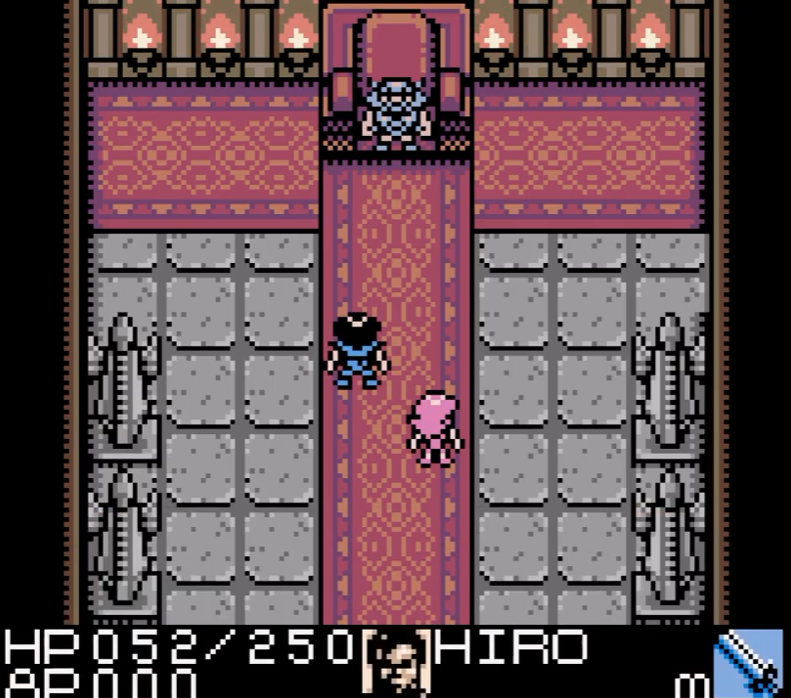
Daikatana is pretty formulaic in how you progress through its various zones and locales. WIth each area kind of feeling like an open-air Zelda dungeon, with its own weapons, keys and little puzzles to solve. So, in each ‘time period’, like Ancient Greece, The Middle Ages or the far flung future Hiro and co. find themselves on their journey, you’ll wander around a little bit, stumbling upon a puzzle or scavenger hunt that’ll send you to wander around a small, branching area, before defeating a boss or two along the way before jumping to another time period and running through the cycle again as you get closer and closer to defeating Kage. Formulaic, yes, but I’d never describe Daikatana as slow; areas are completed at an almost perfect rate, with any particular zone rarely feeling stale before moving on to the next setting. I say that, but that might have something to do with just how short the game is - my run of Daikatana ended just shy of two and a half hours. Not an awful length, considering how short some handheld games of the day could be, but it’s a tough investment considering once you’ve completed Daikatana, there’s literally zero replay value.
You’ll need to complete the odd puzzle here and there, but outside of one slight head scratcher in the game’s final area, it really is just an act of crawling through each area in its entirety to find all the pieces to the puzzle you need. I just wish… any of them were particularly interesting; they’re just all kinds of nothing. The one big thing that sets the game apart from other top-down action-adventures - again, sans Zelda, it’s direct inspiration - is the ability to jump, leading to a small selection of platforming challenges interspaced throughout the game. They’re not anything particularly interesting, but they give Daikatana a spice of variety that can be sorely lacking in its fairly homogenous, samey experience… unless you’re doing any kind of platforming involving moving platforms. Then the game is truly the devil in disguise, since the detection of if you’re standing on an actual platform or empty air is so bad, it took me a good couple of minutes to get through a single platforming screen near the end of the game. Maddening, maddening.
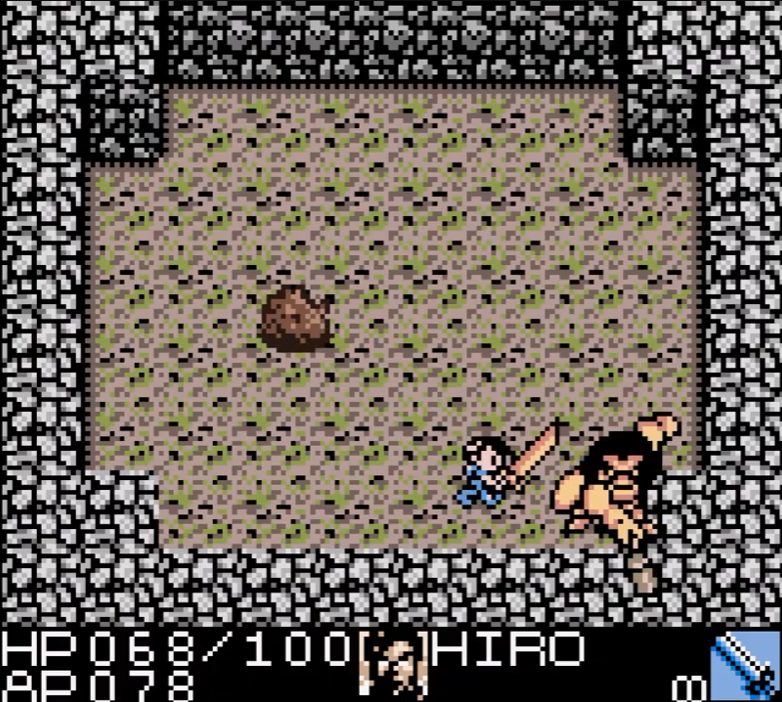
Sadly, unlike the Zeldaesque inspirations that clearly outline its foundation, Daikatana gives you almost no reason, nor opportunity, to explore the selection of time periods Hiro and his companions find themselves in. The game is a largely linear game of forward momentum, only stopped occasionally by the odd puzzle or boss encounter. The rare side-room usually only exists to give you a little bit of ammo or health recovery, but otherwise there are no secrets to sniff out or super-weapons to obtain. This maybe helps contribute to the decent pace of the game, but it just makes it lack that special something that makes it extra memorable; imagine finding something akin to the BFG in a GBC game? Or a weapon that has a single shot that can wipe out anything?
But even without something like the BFG, it’s not like you’re just breezing through these areas without resistance, oh no. Through Daikatana, Hiro and company deal with a *lot* of foes. Endless, mook-like, pathetically inept foes, but foes nonetheless. Combat in Daikatana is incredibly simplistic, almost satisfyingly so, and is probably the bulk of its comparisons to classic 2D Zelda. Equipped with melee weapons, guns and the occasional thrown armament, your arsenal in Daiakata is skilless and spammable, with all of them pretty much able to swung or fired as quickly as you press the button, but there is a simple satisfaction to just carving through the fairly benign foes that exist throughout the timestream. At certain points in the game, you’ll switch from directly controlling Hiro to one of his companions, Mikiko or Superfly. It’s kind of an odd decision, since it rarely has any real story significance and it actually nerfs your general moveset, since Mikiko and Superfly can’t even use the more powerful weaponry Hiro can, leading to sections that whilst similar in structure to the rest of the game, are just more annoying because you’re stuck using outright weaker weapons against the same ‘ol mooks.
I just wish the pretty big arsenal of weapons Hiro and his friends obtain had a bit more variance across it, something that felt *different* and incomparable to its clear Zelda ancestry… Though, the lack of variance makes a little contextual sense; since you’re constantly going different time periods, certain weapons you’ll find, like the crossbow in Greece, obviously won’t have ammo in the 21st century, so the Glock you find then is essentially the crossbow’s replacement. It’s just a little sad to get to the end of the game and have a dozen weapons in your arsenal that realistically only have like… three types of actual weapon styles in there.
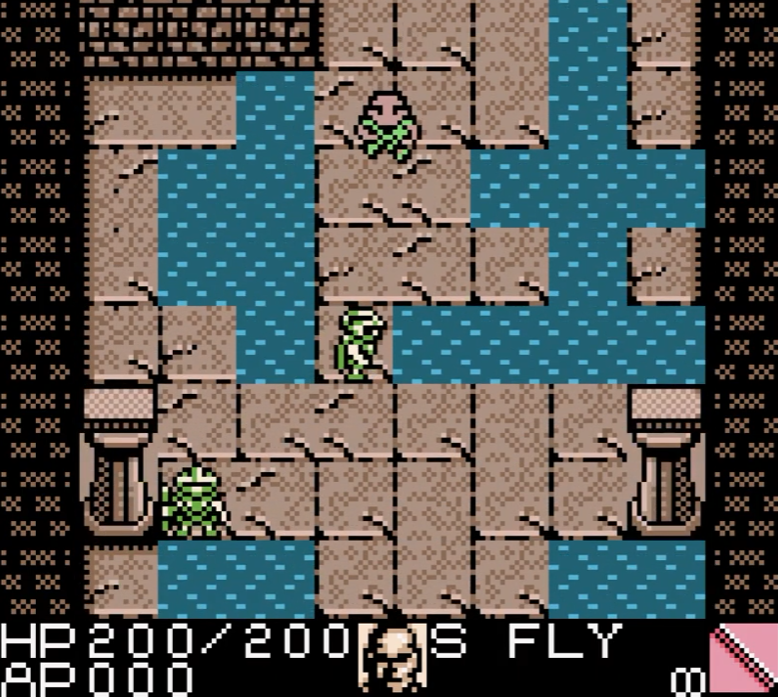
Like with the weapons, there’s really only a handful of enemy types you’ll be dealing with on the regular; goons who’ll charge you to slap you with melee, long-range shooters, and the occasional automated robotic mook, but beyond that, it’s all pretty samey. Even if they all fall into the same set of enemy types, the game does pretty good work in utilizing its pretty limited visuals to make all the enemies different and fitting into their respective time periods. Kudos. But it’s bosses that make up the bulk of the unique encounters in the game… even if they’re ultimately all dealt with the same way as normal mooks - slap them about for a while, just whilst dodging slightly more dangerous, *slightly* more complex attacks. They 100% look cool, no complaints there, but they aren’ *that* different to the endless goons.
Because bosses, however, also represent the jankiest parts of the game. Now, Daikatana is not a difficult game, largely because you can save literally anywhere and at any time, so whenever you come up against something particularly tough, you can reload very, very quickly. Which is good, because some of these boss fights can chunk down your health in only a handful of moments, and they will. They will. Because even if you get good at avoiding enemy projectiles, their bodies have hitboxes that extend way further than their sprite, or they’ll hit you when they’re teleporting around. It just… sucks.
Such annoying, janky hitboxes and abilities leads to bosses frequently felt like they were committing a pretty cardinal sin of boss design in my book; trying to fight them ‘properly’, i.e learning attack patterns, dodging correctly and picking out the right moment to strike, just gave you more time to get your health whittled down by awkward hitboxes and whatnot. Generally, the most efficient strategy was to literally throw yourself at them, spam your ranged weapons or even just use the incredibly fast, high attack speed melee weapons to chunk them down faster than they can kill you. I never once really felt any great sense of satisfaction from beating them - either it was a cheesefest, or they were simply so weak and helpless that I might as well have been fighting normal foes. Again, they look cool and a great usage of the game’s art direction, but they’re just not that fun.
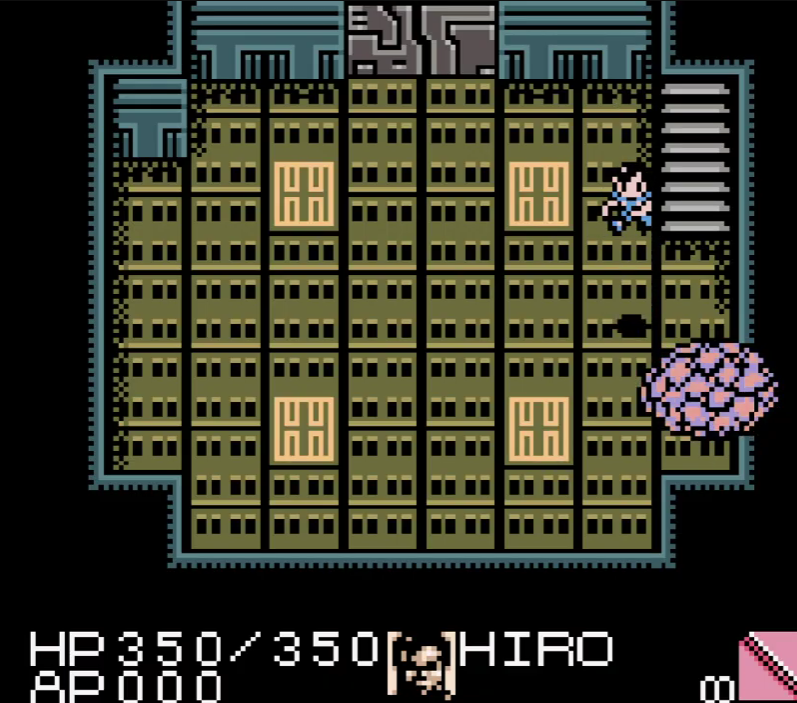
Regardless, though, I couldn’t possibly say anything bad about how the game looks. Genuinely, it’s one of the best usages of the very light, cool colours the GBC utilized, it’s very easy on the eyes and the amount of oaky browns, light maroons, and gentle teals looked great. Each time era has a distinct feel to it separate from the others, and for an adaptation of goddamn Daikatana, Wise did a bang-up job adapting it to such a limited format. Unfortunately, they couldn’t perform miracles when it came to the audio, and that’s less on them and more just how shlocky a huge chunk of GBC soundtracks were. I feel only Nintendo were able to work magic with it - in Daikatana’s case, on the rare cases that the soundtrack isn’t drilling holes into your temples, the beats that pepper it throughout are so repetitive and samey, I was very quick to throw the game on mute and take a look at a longplay to get an overall take on how it sounded.
Before I close out this review, I just want to say that even if I didn’t particularly think much of it, I’m over the moon that Daikatana for the GBC even exists. Sure, it wasn’t like every PC game or whatever received this treatment - the GBC version probably only exists because John Romero thought Daikatana was to be a phenomenon akin to Doom or Quake, a truly generational game. But the fact that quite a few games received bizarre demake/ports, incredibly different, but still loyal to their source material was an incredible moment in video game history that’s just sort of… gone away with the somewhat homogenic specs every gaming platform has these days. Daikatana GBC isn’t great, but from what I’ve seen, it’s head and shoulders above the PC version, and the sheer virtue of its existence makes it valuable.
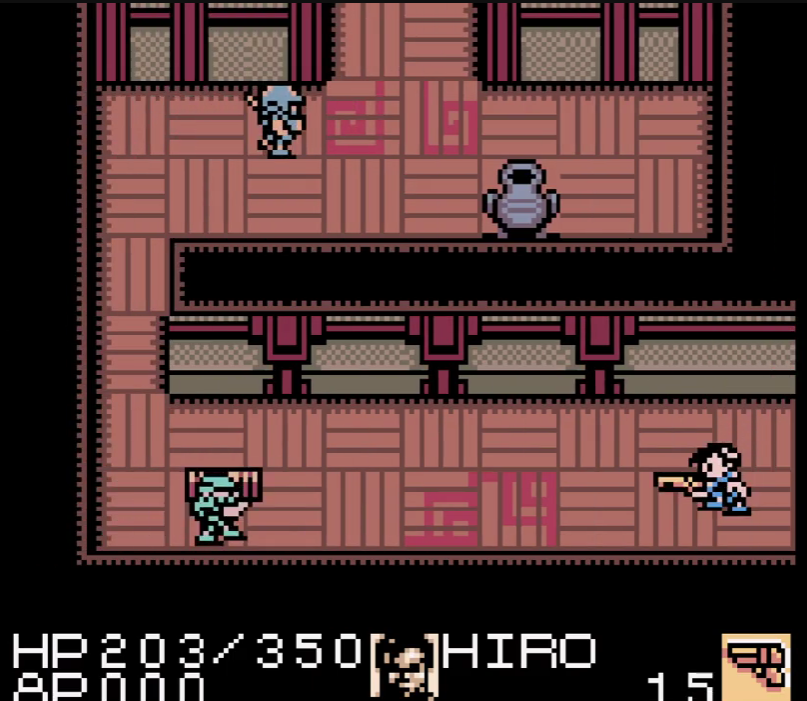
Because ultimately, the fact that Daikatana for the Game Boy Color exists is more interesting than anything the game is actually doing. Sure, it’s a perfectly serviceable Zeldaesque action-adventure that does few things good, but equally few things bad. It’s just one of those weird games that… just exists. The fact it’s a goddamn adaptation of Daikatana will probably be the sole thing stopping it fading from my memory in a month or two, but if it was anything else, it’d be just that case.